Battery Storage Revenue Stacking
Why a battery’s revenue streams compete for the same megawatts, and what to ask for instead of the sum
Jacopo Buriollo, founder and CEO, Megawatt
In brief
Revenue stacking is usually presented as a battery’s great advantage: it can earn from energy arbitrage, capacity payments and ancillary services at once. But those streams compete for the same megawatts and the same stored energy at the same moment. Adding them together produces an upper bound rather than a forecast. What a battery really earns depends on the dispatch priority order and the objective its optimiser is given, and both can be written down and disclosed.
The usual battery storage revenue model
A battery energy storage system (BESS) can earn in several ways:
- Energy arbitrage: charging when electricity is cheap and discharging when it is expensive.
- Capacity payments: being paid to be available when the system needs it.
- Ancillary services: helping keep the grid stable by holding capacity ready to respond to frequency changes, in either direction.
Most models show each of these as a separate revenue line, estimated on its own, then add them up. The appeal is obvious. Each line looks reasonable, often conservative. The total looks like a battery that earns from everything at once.
Why the streams compete
A battery is one physical resource. At any moment it has a fixed amount of power it can deliver and a fixed amount of energy stored.
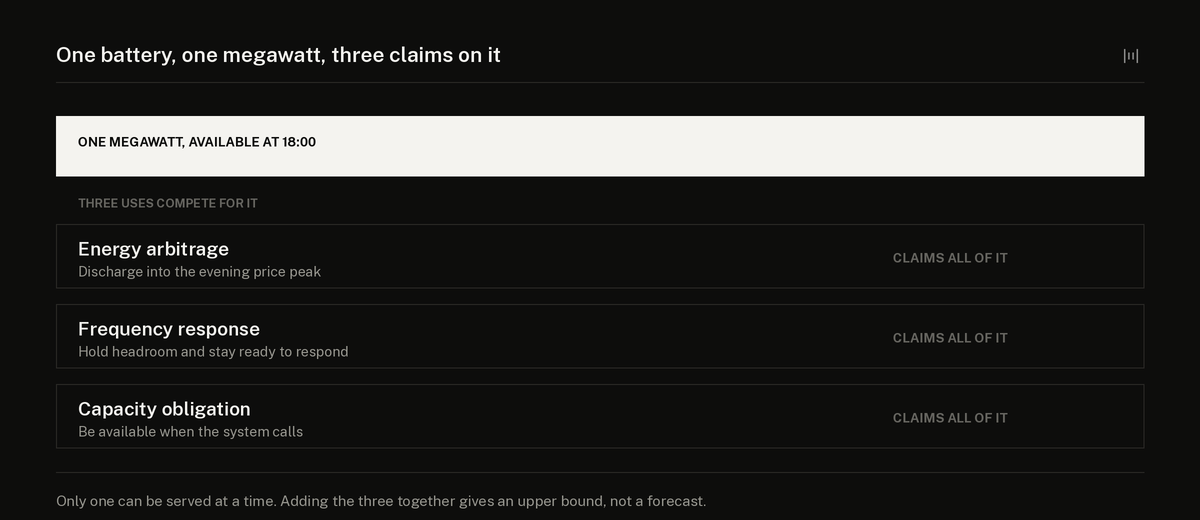
Each revenue stream makes a claim on that resource:
- Arbitrage wants the battery charged and free to discharge at the most expensive hours.
- Capacity wants it available at a specific moment, which means not committed elsewhere.
- Ancillary services want headroom held back in both directions, so the battery can respond up or down on request.
These are claims on the same megawatts at the same time. A battery holding headroom for frequency response cannot also discharge fully into a price spike. A battery committed to capacity cannot use that capacity for something else in the same hour.
So adding the lines together double-counts. Each line can look conservative on its own while the sum describes an asset that doesn’t exist.
The sum is an upper bound
The honest way to read a stacked revenue model is as an upper bound: what the battery could earn if every stream could be served at once, which it can’t.
The real figure sits below that bound, and where it sits depends on a choice somebody makes.
The dispatch priority order
When two revenue streams want the battery at the same moment, something has to decide which one wins. That decision is the dispatch priority order, and it is set when the optimiser, the software that runs the battery, is configured.
Whatever sits highest in that order gets the capacity first. Everything below takes what is left.
The important point is that this order is deterministic. It is a choice somebody made, rather than a probability or a market outcome, which means it can be written down. And once it is written down, it can be examined, questioned and valued.
Almost nobody discloses it. Most revenue models present the stacked sum without saying which stream takes priority when they collide.
The objective behind the order
The priority order gives you the ranking. It doesn’t tell you everything.
Behind the order sits the optimiser’s objective: what it is actually trying to maximize. The order tells you which stream wins in a straightforward conflict. The objective tells you what the optimiser does in all the cases the order doesn’t cover, including how hard it is willing to use the battery to earn a little more.
That is where the interests of the owner and the optimiser can quietly diverge. An optimiser paid on the revenue it generates has every reason to cycle the battery harder. The owner carries the cost of that cycling: faster degradation, lost availability, and a battery with less capacity in its later years.
An objective written around revenue alone will run the asset differently from one that prices in the cost of wear. Both can produce a good month. Only one protects the asset over its life.
What to ask for
Anyone assessing a battery’s revenue, whether buying one, investing in one or valuing a portfolio, can ask for four things:
- The dispatch priority order. Which revenue stream takes precedence when they conflict.
- The optimiser’s objective. What it is set up to maximize, and whether the cost of degradation is part of it.
- Dispatch records. Why the battery was dispatched when it was, and what alternatives were available at the time.
- Degradation accounting. How the effect of dispatch decisions on the battery’s condition is measured over time.
All four are configuration choices and operating records rather than trade secrets. Disclosing them turns a revenue model from a sum of optimistic lines into a description of how the asset will actually be run.
Why it will change
Revenue stacking is described as a benefit, and it is one. But it is also the least examined assumption in most battery storage models.
That will change the first time an asset is valued on the strength of a disclosed priority order and objective, rather than on the stacked sum. Once one owner can show exactly how their battery will be run, it becomes much harder for anyone else to present the sum on its own.
Key questions
What is revenue stacking in battery storage? Earning from several sources with one battery: energy arbitrage, capacity payments and ancillary services such as frequency response.
Can a battery earn from all revenue streams at once? Not fully. The streams compete for the same power and stored energy at the same moment, so the sum of separately estimated revenue lines is an upper bound.
What is a dispatch priority order? The rule, set when the optimiser is configured, that decides which revenue stream gets the battery first when two want it at the same time.
Why does the optimiser’s objective matter? Because it decides how hard the battery is used. An objective based on revenue alone can earn more in the short term while degrading the battery faster.
What should investors ask for when assessing a battery’s revenue? The dispatch priority order, the optimiser’s objective, dispatch records, and how degradation from dispatch decisions is measured.