Battery Storage Revenue Benchmarks
Why published benchmarks for the same market disagree, and how to get from a benchmark to what a battery actually keeps
Jacopo Buriollo, founder and CEO, Megawatt
In brief
Most battery storage revenue models start from a published benchmark: a figure, usually in euros per megawatt per year, for what a reference battery earned in a given market. But benchmarks for the same market and the same month can sit far apart. In August 2026, the highest published benchmark for a two-hour battery in Germany was 62% above the lowest. The gap comes from assumptions: how much the model knows about future prices, how often the battery is available, how hard it cycles, how much of its capacity it can use, and which costs are taken off. A benchmark is a useful anchor, as long as you know which of those assumptions it carries and translate them to the asset in front of you.
The number every model starts from
Battery storage revenue is hard to observe directly. Individual assets rarely publish what they earn, and the ones that do are not always comparable. So the industry relies on benchmarks: indices and models that estimate what a reference battery would have earned in a market over a month or a year.
They are genuinely useful. They make markets comparable, show how revenue moves over time, and give anyone building a model a place to start. The risk is treating one as a fact about the market, rather than as the output of a model with its own assumptions.
Same market, same month, different answers
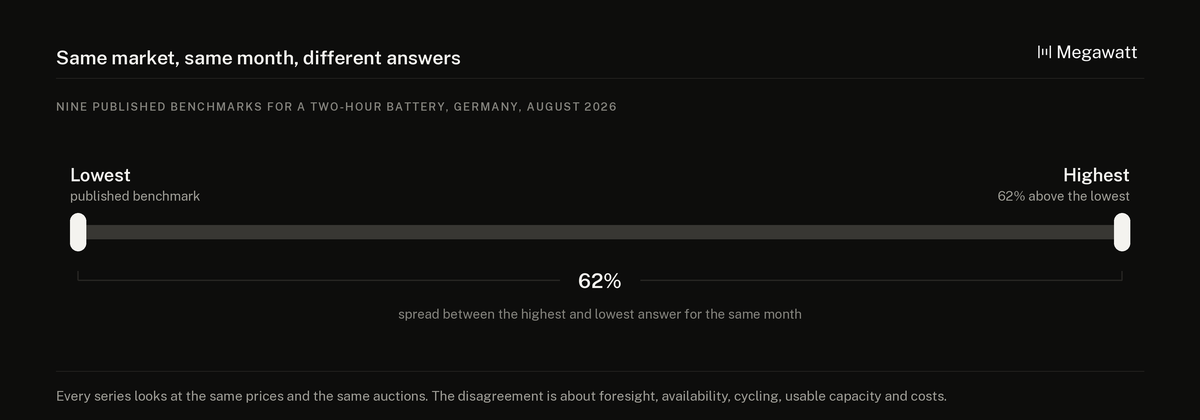
A public comparison at bess-index.com tracks nine benchmark series for two-hour batteries in Germany, Belgium and Spain. For Germany in August 2026, the highest benchmark was 62% above the lowest.
That is not a disagreement about the market. Every series is looking at the same prices, the same auctions and the same month. It is a disagreement about the battery: what it knew, how often it was there, how hard it worked and what it paid.
Why benchmarks disagree
Foresight. Some benchmarks optimise the battery with perfect knowledge of prices and activations over the period. That is a legitimate way to measure what the market offered, and an unreachable one for a real asset, which has to commit before it knows. A perfect-foresight benchmark is an upper bound by construction.
Availability. Modelled cases often assume the battery is available 98 to 100% of the time. Real fleets sit lower once outages, curtailment and downtime for augmentation are counted.
Cycling. Assumptions range from one full cycle a day to between one and a half and two. More cycling earns more in the model. In the asset, it also uses up more of the battery’s life, and the benchmark figures in that comparison do not account for degradation.
Usable capacity. Some benchmarks let the battery use its full state of charge. Others keep a margin at the top and bottom and use 90% of it, which is closer to how batteries are operated and warranted.
Costs. Benchmarks generally report gross market revenue: before grid fees, before imbalance and non-delivery charges, before the optimiser’s share. Those costs vary by market, by contract and by operator, and they can be a large part of the difference between what a battery earns and what its owner keeps.
Modelled and realised
Most benchmarks are model outputs. A few are built differently: in the same comparison, one series reports realised trading performance, and another is assembled bottom-up from the metering of an operating fleet.
Those are the closest thing the market has to evidence. They are not perfect either, because a fleet’s results reflect its own locations, durations and contracts. But they answer a different question. A model says what a battery could have earned. Realised data says what batteries did earn.
From a benchmark to what an asset keeps
Getting from a benchmark to a figure an investor can rely on is a sequence of adjustments, each one specific to the asset:
- Start from the benchmark, and know how it was built. Foresight, cycling, usable capacity and the treatment of costs all need to be stated.
- Adjust for foresight. Replace perfect foresight with a realistic capture rate for the operator and its strategy, ideally supported by that operator’s track record.
- Adjust for availability. Use what the warranty and the service agreement actually guarantee, not the model’s default.
- Adjust for cycling and wear. Match the cycling to the warranty’s limits, and price the degradation that cycling causes.
- Take off the costs. Grid fees, imbalance and non-delivery charges, and the optimiser’s fee or revenue share.
What remains is the figure that matters. It will be lower than the benchmark, sometimes much lower, and that is not a sign that anything is wrong. It is the difference between what the market offered and what a particular battery, under a particular set of contracts, can take.
The same discipline applies when a model adds several revenue streams together, which is covered in Battery Storage Revenue Stacking.
Why it matters for financing
Capital is committed against the revenue that survives a poor year, not the revenue a benchmark shows in an average one. A model anchored on a perfect-foresight, full-availability, pre-fee benchmark starts from a number no asset can reach, and every adjustment it skips flatters the result.
Lenders know this, and they apply their own discounts. The trouble is that those discounts are blunt. A model that makes each adjustment explicitly, and shows the evidence behind it, gives a lender something to examine rather than something to cut.
What to ask for
Anyone reading a battery revenue model, whether to buy, invest in or lend against the asset, can ask:
- Which benchmark is the model built on, and what does it assume about foresight, availability, cycling, usable capacity and costs?
- How do those assumptions compare with this asset’s warranty, service agreement and optimisation contract?
- Is there realised data, from this operator or from comparable assets, to support the capture rate?
- Which costs have been taken off, and which are still inside the headline figure?
Where this is heading
Benchmarks will converge as more realised data becomes available. Every operating asset that publishes metered output and settled revenue narrows the space in which models can disagree. Until then, the most useful thing a benchmark can come with is a clear statement of what it assumes, and the most useful thing a model can do is show how it got from that benchmark to the asset.
Key questions
What is a battery storage revenue benchmark? A published estimate of what a reference battery earned in a market over a period, usually expressed in euros per megawatt per year.
Why do benchmarks for the same market disagree? Because they make different assumptions about foresight, availability, cycling, usable capacity and costs. In Germany in August 2026, the highest published benchmark for a two-hour battery was 62% above the lowest.
Is a perfect-foresight benchmark a forecast? No. It measures what the market offered to a battery that knew prices in advance. It is an upper bound that no real asset can reach.
What is the difference between gross and net battery revenue? Gross revenue is what the battery earns in the market. Net revenue is what remains after grid fees, imbalance charges, the optimiser’s share and the cost of wear.
What should investors ask when a model cites a benchmark? Which benchmark it uses, what that benchmark assumes, how those assumptions compare with the asset’s contracts, whether realised data supports the capture rate, and which costs have been deducted.
Source: bess-index.com, comparison of published two-hour battery revenue benchmarks, Germany, August 2026. Accessed October 2026.