What a Place in the Queue Is Worth
A grid connection offer is a date on paper. How often that date holds, and what it means for anyone valuing a solar or battery project
Jacopo Buriollo, founder and CEO, Megawatt
In brief
Capital, equipment and land can all be bought. A grid connection has to be waited for, and the wait is measured in years. A place in a connection queue gives a project the right to connect at a given point on a given date, and that date moves more often than the paperwork suggests. One analysis of Great Britain’s connection register found that about one in four battery projects connected by their contracted date, with the odds rising sharply as projects advanced. A queue position is best valued as an option: worth what it is likely to deliver, and when.
The slowest input
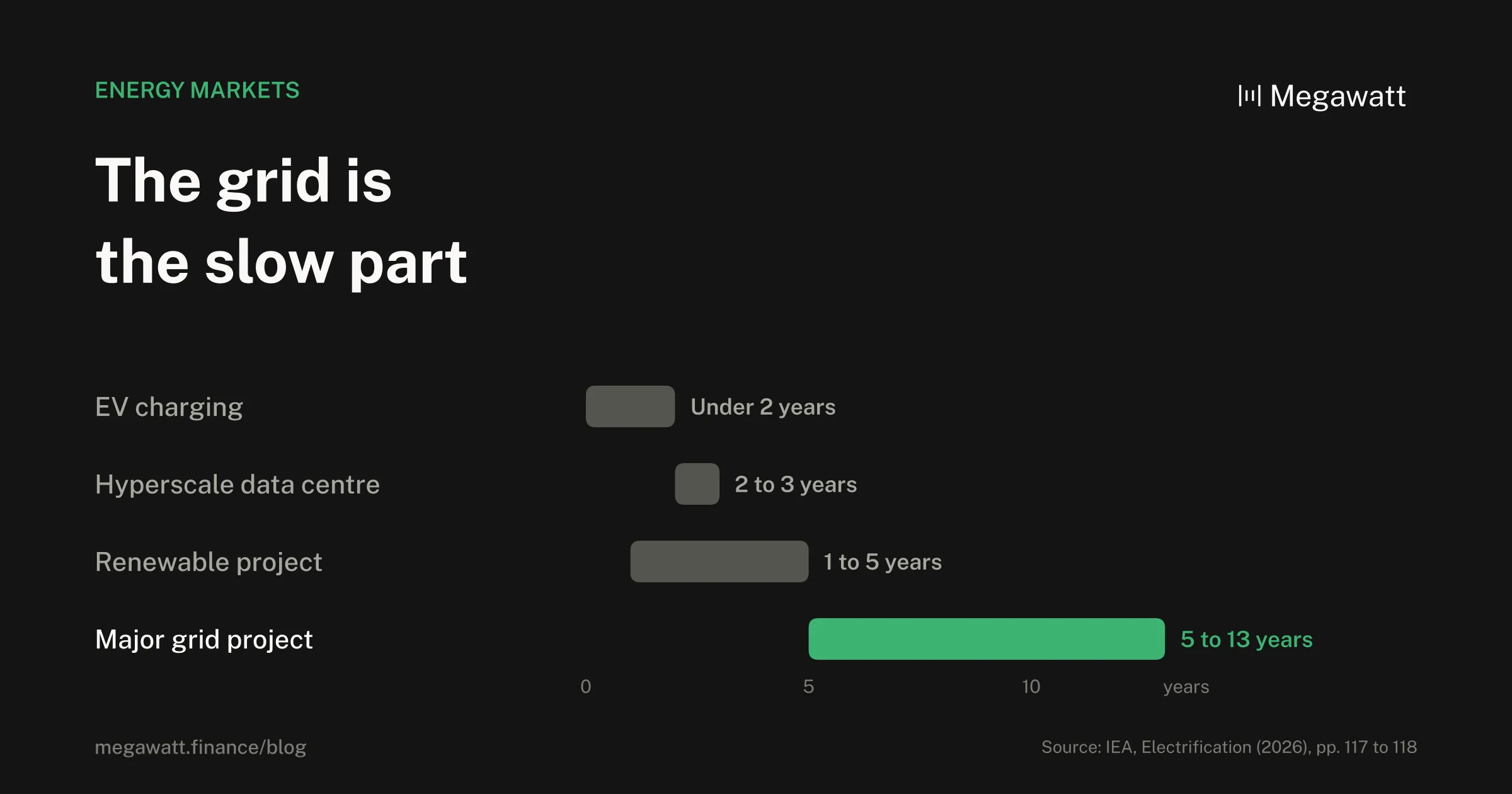
The IEA’s Electrification report, published in September 2026, sets out the mismatch in timing. A major grid project takes five to thirteen years. A renewable project takes one to five, EV charging under two, and a hyperscale data centre can go from announcement to operation in two to three. Generation and demand are being built faster than the network that connects them.
The result is queues. IRENA counts about 2,500 GW of advanced-stage renewable, storage and large-load projects waiting for grid connections worldwide. In Germany alone, grid operators received 18,158 applications to connect battery storage at medium voltage and above in 2025, for about 573 GW, and made 1,937 binding connection offers covering about 54 GW, according to Bundesnetzagentur data. Many applications are the same project filed at several sites, so the totals overstate real projects. They still show where the bottleneck sits.
How often the date holds
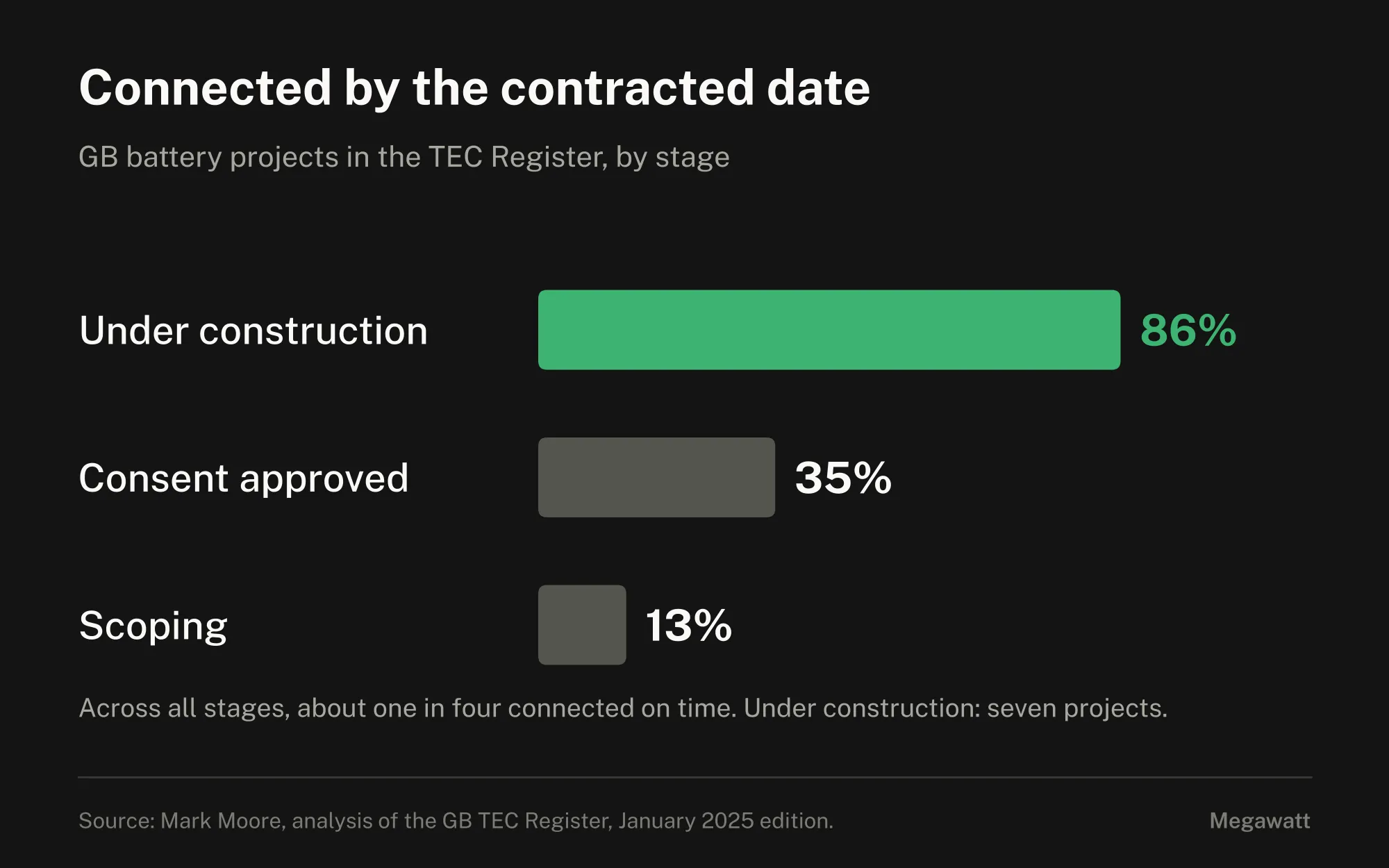
Mark Moore took the battery projects listed in the January 2025 edition of Great Britain’s Transmission Entry Capacity (TEC) Register, which records projects holding transmission connection agreements, and checked which had connected by the date in their contract. About one in four had.
The stage each project had reached made most of the difference:
- Under construction: 86% connected on time, from a small group of seven projects.
- Consent approved: 35%.
- Scoping: 13%.
Where dates moved, the median slip was twelve to fourteen months, and some projects were still listed against connection dates that had already passed.
So a pipeline is worth what each of its stages is likely to deliver. A list of capacity by contracted connection date, with no adjustment for stage, overstates both how much will connect and when.
Why a queue position is an option
An option gives the right to do something without the obligation. Until recently, a place in most connection queues worked exactly that way, and it cost little to hold. A developer could secure a position, wait to see whether the project could be permitted and funded, and walk away if not. Positions held for projects that would never be built sat ahead of projects that would.
That makes a queue position a different kind of asset from land. Another field can usually be found. A position in a particular queue, at a particular substation, with a particular date, cannot. Its value depends on the process that governs the queue, and it can rise or fall without anything changing on site.
Long queues also favour whoever can afford to wait. A five-year queue filters out anyone who cannot fund five years of nothing, so rules meant to widen competition can end up rewarding the largest balance sheets.
Regulators are pricing the option
Across Europe, holding a queue position now costs money, evidence of progress, or both:
- Germany. From 1 April 2026 the transmission system operators replaced first come, first served for large batteries with a procedure based on project maturity. It assesses land and permits, the technical and connection concept, the applicant’s economic capability, and the project’s benefit to the grid.
- Great Britain. The reformed queue, known as Gate 2, re-orders projects by readiness and confirms a date, a connection point and a position. It is a connection right. Planning consent and a ready-to-build project still have to be earned separately, and an offer window is a different thing from an energisation date.
- Parts of Central and Eastern Europe. Developers now post a bank guarantee or performance security per megawatt when they sign a connection agreement, and lose some or all of it if the project is abandoned.
- The Netherlands. Users who accept curtailment at peak times can connect sooner.
The two approaches filter on different things. A flat fee per megawatt filters on balance sheet: a well-funded sponsor with a speculative site clears it easily, and a smaller developer with a permitted project may struggle. A maturity test aims at the actual problem, projects that will never be built, though it is harder to administer.
Firm and flexible connections
Connections also differ in what they promise. A firm connection guarantees the right to export up to an agreed capacity. A flexible, or non-firm, connection can be offered sooner, on condition that the project can be told to reduce its output when the grid is congested. The IEA estimates that flexible connections could unlock 750 to 900 GW of extra hosting capacity worldwide, and grid-enhancing technologies a further 450 to 700 GW.
For the system, flexible connections use the grid more efficiently. For an investor, they change what the asset can deliver: the curtailment terms decide how often, in which hours and with what compensation the asset is held back. Two projects of the same size, one firm and one flexible, are different investments, and should be valued as such.
What to ask for
Anyone valuing a project with a grid connection can ask:
- What stage is the project at, and how often have projects at that stage connected on time in this market?
- Is the connection firm or flexible, and what are the curtailment terms?
- What security or deposit has been posted, and what is lost if the date moves or the project is abandoned?
- What has to happen before energisation: substation works, reinforcement, line extensions, and who pays for each?
- Has the connection date already moved, and how many times?
- Does the cost estimate include the line from the site to the grid, which is often missing from early quotes?
Where this is heading
Grid investment is rising. The IEA puts it at about USD 450bn in 2025, up from about USD 315bn in 2015, partly because transformers and cables became more expensive. Connection reform will thin the queues, and maturity tests should make a date in a connection agreement more reliable than it has been. Until then, a pipeline quoted in gigawatts says little about what will connect, or when. The figure to look for is the capacity with a firm date and the evidence to back it.
Key questions
What is a grid connection queue? The list of projects waiting for the right to connect to the electricity network, each usually with an assigned connection point and date.
How often do battery projects connect on their contracted date? In one analysis of Great Britain’s TEC Register, about one in four battery projects connected by their contracted date. Projects under construction did far better than those still in consenting or scoping.
Why is a grid queue position described as an option? It gives a project the right to connect without obliging it to build, and until recently it cost little to hold, so many positions belonged to projects that would never be built.
How are regulators reforming connection queues? By testing project maturity, as Germany and Great Britain now do, and by requiring guarantees or deposits per megawatt that are partly or fully lost if a project is abandoned.
What is the difference between a firm and a flexible grid connection? A firm connection guarantees the right to export up to an agreed capacity. A flexible connection can be available sooner, but the project can be curtailed when the grid is congested.
Sources: IEA, Electrification (Special Report, September 2026), pp. 34, 95 and 117 to 119; IRENA, as reported by Anadolu Agency (22 September 2026); Bundesnetzagentur connection data for 2025, published August 2026; Mark Moore, analysis of the GB TEC Register (January 2025 edition); German transmission system operators, press release of 5 February 2026.