A Number You Can Check
Verifying real-world asset data starts with the source, not the oracle
Jacopo Buriollo, founder and CEO, Megawatt
In brief
Most investors in energy infrastructure learn how their asset performed from a report prepared by the people who run it, weeks after the fact. Every solar farm and battery already has a better source: the settlement meter at its grid connection, which the grid operator and the electricity buyer both rely on. Publishing that reading as it happens turns a number investors are given into a number they can check.
The quarterly report problem
Ask how an investor in a solar farm or a battery knows what it produced last month, and the honest answer is usually: somebody told them.
A report arrives, quarterly or monthly, prepared by the operator or the manager. It is often accurate. But it is a number the investor is given, assembled by the party whose performance it describes, and it arrives long after anything could have been done about it.
The cause is structural rather than bad faith. Any figure measured and reported by the party with a stake in it will tend to drift in one direction, not through dishonesty but through definitions, rounding and the thousand small choices involved in turning raw data into a report.
There is evidence of how large that drift can be. A study of more than 50 operating battery projects by ACCURE Battery Intelligence, built with U.S. Bank, found that three out of four sites over-report their own availability. The median reported by the sites’ own energy management systems was 96.7%, against 94.1% when measured independently, and in the bottom tenth of sites the gap widened to six percentage points. The main reason was definitional: many systems count a unit as available once it reports itself online, even if it does not respond when called on.
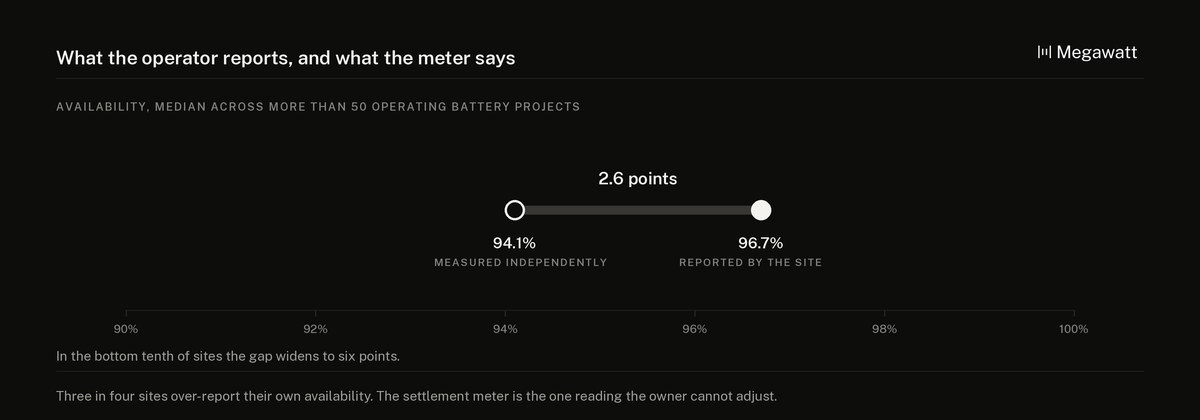
A gap of that size is enough to change what an asset is worth. And it was invisible to anyone relying on the reported figure.
What a settlement meter is
Every farm that sells electricity to the grid has a meter at the point where it connects. It measures how much electricity actually crossed into the grid, in each settlement period.
That meter exists for a specific reason: settlement. The grid operator uses it to account for what the farm delivered, and whoever buys the electricity uses it to calculate what they owe. It is installed, calibrated and read under grid rules.
Which gives it a property no operator report has. It is not the owner’s number to adjust. Two parties with opposing interests, the seller and the buyer of the electricity, both rely on it. If it were wrong in the owner’s favor, the buyer would be overpaying. It is about as close to an independent measurement as a physical asset gets.
Two layers, kept separate
It helps to be precise about what the meter can and cannot tell you.
What the asset produced. The meter settles this directly. How many megawatt-hours were delivered, when, and in which periods. This layer can be verified against a reading that neither side controls.
What the asset earned. This depends on prices, contracts and how the asset was dispatched. It is a separate layer, built from settlement statements and contract terms rather than from the meter alone.
Most reporting blends the two into a single figure. Keeping them apart matters, because it tells you where a shortfall came from. An asset that produced as expected but earned less points to prices or contracts. An asset that produced less points to the equipment, the site or the way it is run.
Why the oracle is the easy part
Much of the conversation about real-world data onchain focuses on the oracle: the mechanism that carries an off-chain number onto a blockchain. It matters, but it is the easy part.
An oracle faithfully delivering a number the operator typed in is still delivering a number the operator typed in. Putting a figure onchain makes it permanent and visible. It does not make it true.
So the useful questions about real-world asset data are where the number comes from, who else relies on it, and whether anyone with an opposing interest would notice if it were wrong. For energy infrastructure, the settlement meter answers all three.
What changes when the reading is published
Publishing the settlement reading continuously, rather than summarizing it quarterly, changes three things.
Problems show up in weeks, not at the next report. Degradation running ahead of the manufacturer’s curve, availability falling, output lost to curtailment, or dispatch choices that earn revenue while wearing the equipment faster. All of these leave a trace in the data long before they appear in a summary.
Incentives line up. An operator who knows its results are visible as they happen has every reason to run the asset for its long-term value rather than for the next reporting date.
A future buyer can price the position. An illiquid asset becomes easier to hold, and easier to sell, when anyone can see its actual record. The data won’t make a solar farm trade like a share, but it gives the right investor the confidence to hold it, and the next investor the evidence to value it.
What it does not solve
A published meter reading is not a legal claim. It tells an investor what the asset did. What they are entitled to if something goes wrong still depends on the structure around it.
It does not cover the revenue layer on its own. Prices and contract terms need their own sources.
And it depends on the meter itself: installed correctly, read reliably, and carried onchain without gaps. Those are solvable problems, but they are real ones.
How Megawatt is approaching it
Megawatt finances utility-scale solar and battery storage projects across Central and Southeast Europe, held through dedicated SPVs. It is building its investor reporting around the settlement reading, published as it happens, so that anyone holding a position can check what the farm produced rather than waiting to be told.
Key questions
How can real-world asset data be verified onchain? By starting from a source that the operator does not control. For energy assets, that is the settlement meter at the grid connection, which the grid operator and the electricity buyer both rely on.
What is a settlement meter? The meter at the point where a farm connects to the grid. It measures the electricity delivered in each period, and it is used by the grid operator and the buyer to settle what was delivered and what is owed.
Is an oracle enough to make real-world data trustworthy? No. An oracle carries a number onchain faithfully, but it cannot make that number true. The source of the data matters more than the mechanism that transports it.
Why do operators over-report performance? Usually through definitions rather than dishonesty. A study of over 50 battery projects found three in four over-reported their availability, largely because units were counted as available when online, even if they did not respond.
What does a meter reading not tell investors? What the asset earned, which depends on prices and contracts, and what the investor is legally entitled to if something goes wrong.
Source: ACCURE Battery Intelligence and U.S. Bank, "Banking BESS" report (2026).