Liquidity Is an Option, Not a Constant
Are tokenized real-world assets liquid? What holders of long-lived assets actually need from an exit
Jacopo Buriollo, founder and CEO, Megawatt
In brief
Tokenized real-world assets are often sold on the promise of liquidity, but putting an asset onchain does not make it liquid. For assets that pay out over years, liquidity works more like an option: holders rarely use it, but they need to know it exists. What they need is a credible exit window, a price they can understand, and someone with a reason to be on the other side.
The constant view of liquidity
Liquidity usually gets talked about as a fixed property. An asset either trades continuously, like a large-cap stock, or it is stuck.
Under that view, the case for tokenizing a real-world asset is simple: put it onchain, let it trade around the clock, and an illiquid asset becomes a liquid one.
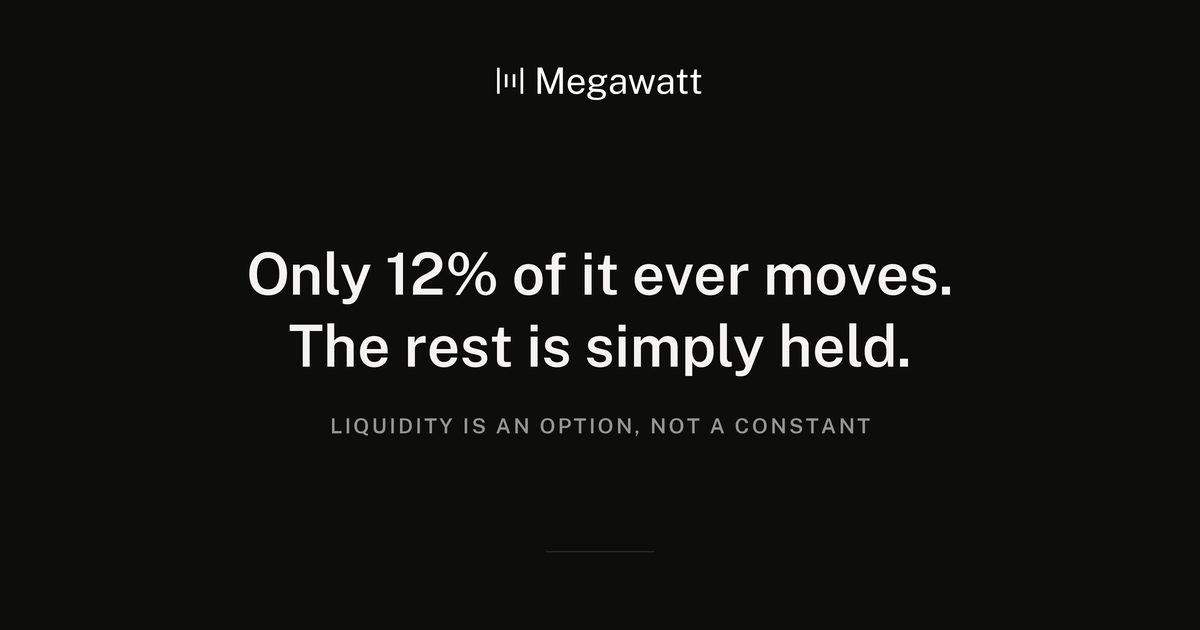
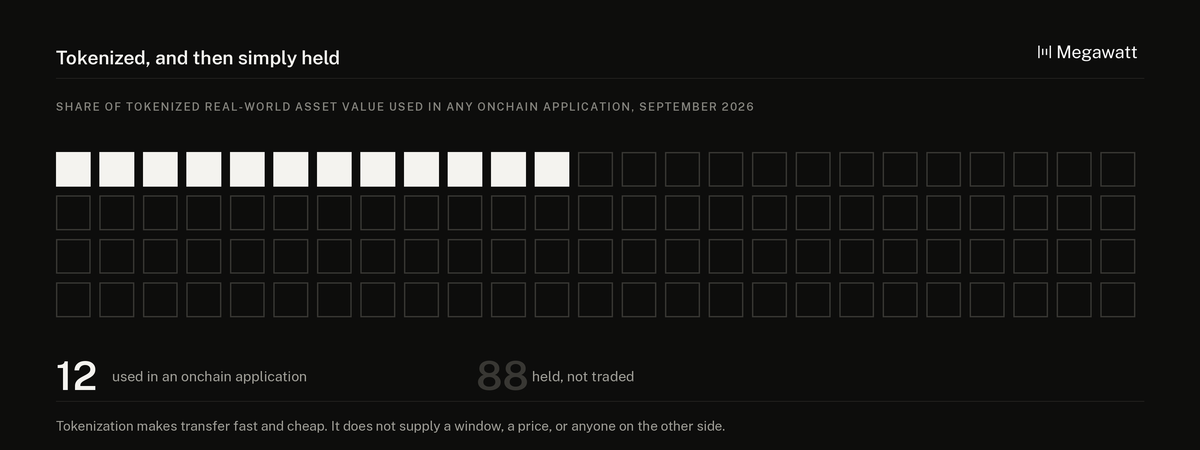
The numbers so far say otherwise. Binance Research estimated in September 2026 that only about 12% of tokenized real-world asset value was being used in any onchain application at all. Most of the rest is held, not traded. For many of those holders, that is exactly right: they bought tokenized treasuries for the yield and have no reason to sell.
The constant view misreads what those holders want.
Liquidity as an option
For most holders of a long-lived asset, liquidity works like an option. They rarely exercise it. Many never will. But its existence changes what they are willing to hold, and at what price.
What they need from that option is specific:
- A credible exit window. Confidence that they could leave within a reasonable period if they had to.
- A price they can understand. A way to see what their position is worth, and why, without relying entirely on the issuer’s word.
- Someone with a reason to be on the other side. Somebody whose interests are served by taking the position when they want out.
The third is the one most often assumed rather than examined.
Why continuous trading is the wrong target
Continuous trading is expensive to manufacture for an asset that pays out over decades. Every hour a market is open, someone has to be ready to quote a price, and for an asset with few holders and rare trades, that readiness costs money.
Most of the shortcuts used to produce the appearance of liquidity end up costing the holder somewhere else: in the returns they give up, in the price they accept when they do sell, or in exposure they didn’t realize they were taking on.
Treating continuous trading as the goal gets the priority backwards. What holders of long-lived assets value is certainty about the exit, and certainty is cheaper to provide than constant motion.
How other markets handle it
Plenty of markets are considered liquid even though most of what trades in them changes hands rarely. Many corporate bonds go days or weeks without a trade and are still treated as liquid.
What those markets have is someone who earns a living making prices. A dealer stands ready to quote, because quoting is how they make money. The asset doesn’t need to trade constantly. Somebody just needs a reason to be there when it does.
What tokenization changes, and what it doesn’t
Tokenization does real things for liquidity. Transfer becomes faster and cheaper. Ownership becomes clearer. Settlement can happen at any hour. Those are genuine improvements, and they make an exit easier to execute.
What tokenization cannot do, on its own, is give anyone a reason to be on the other side. A token makes selling mechanically easy. It does nothing to create a buyer.
When liquidity disappears
There is a harder question underneath all of this: under what conditions does the exit stop working?
Liquidity mechanisms tend to be tested at exactly the moment their economics stop working, when many holders want the same side of the trade at once. A promise of liquidity that holds on a normal day and disappears on a bad one is worth much less than it appears.
So an honest answer to “can I exit” usually comes with conditions attached. A holder is far better served knowing those conditions in advance than discovering them during a bad week.
Transparency is part of liquidity
One lever is underrated. For an illiquid asset, radical transparency does some of the work that trading does in a liquid one.
A future buyer can only price a position they can see into. Continuous, verifiable performance data, such as the output a farm actually delivered, lets the next investor value the position without starting from zero. It won’t make a solar farm trade like a share, but it makes the right investors comfortable holding it, and gives the next one the evidence to buy it.
The question that matters
For a long-lived asset, what holders are really buying is confidence that they could leave, and on what terms. Everything else about liquidity follows from how honestly that question is answered.
Key questions
Are tokenized real-world assets liquid? Not automatically. Tokenization makes transfer faster and cheaper, but liquidity depends on buyers and someone willing to take the other side. In September 2026, only about 12% of tokenized real-world asset value was used in onchain applications.
What liquidity do holders of long-lived assets actually need? A credible window to exit, a price they can understand, and someone with a reason to be on the other side. Most rarely sell, but need to know they could.
Does tokenization create liquidity? It makes an exit easier to execute. It does not, on its own, create a buyer.
Why do some rarely traded markets still count as liquid? Because someone earns a living making prices in them, so there is a quote available when a holder wants to sell, even if trades are infrequent.
How does transparency affect liquidity for illiquid assets? Verifiable performance data lets a future buyer value a position without starting from zero, which makes the asset easier to hold and to sell.
Source: Binance Research, "The RWA Activation Era" (September 2026).