Which Record Counts
A token balance and a legal register can disagree. Why that decides what a tokenized asset holder owns
Jacopo Buriollo, founder and CEO, Megawatt
In brief
Every security has a register: the legal record of who owns it. A blockchain is also a record of who holds what, and it updates in seconds. When a security is tokenized, the two either stay separate or become one. If they stay separate, the token mirrors the register, and the register wins when they disagree. If the law or the record-keeper recognises the chain, the token is the record. Both models launched at scale in 2026. For anyone holding a tokenized asset, the first question is which record counts, and what happens in any gap between the two.
What a register is
The register is the legal record of who owns a security. Certificates, statements and confirmations are evidence pointing at it. When a court decides who was entitled to a payment, who could vote or who owns what in an insolvency, the register is what it reads.
Issuers rarely keep their own. A transfer agent maintains the register on their behalf: it records each transfer so ownership actually moves, works out who held what on the record date for every payment or redemption, and handles investor communications and tax reporting. Put simply, the job is answering “who owns this, right now, and what are they owed?”
In public markets most investors never appear on the register at all. It usually shows a nominee, and the investor holds a claim several layers down, through a central depository, a custodian and a broker. Ownership is already less direct than most people assume.
Two records, one asset
A blockchain is structurally a register. It records holders and updates on every transfer, with no one reconciling it afterwards. Whether a chain can do the job technically was settled years ago. The open question is legal: does the law treat the chain as the register, or as a copy of it?
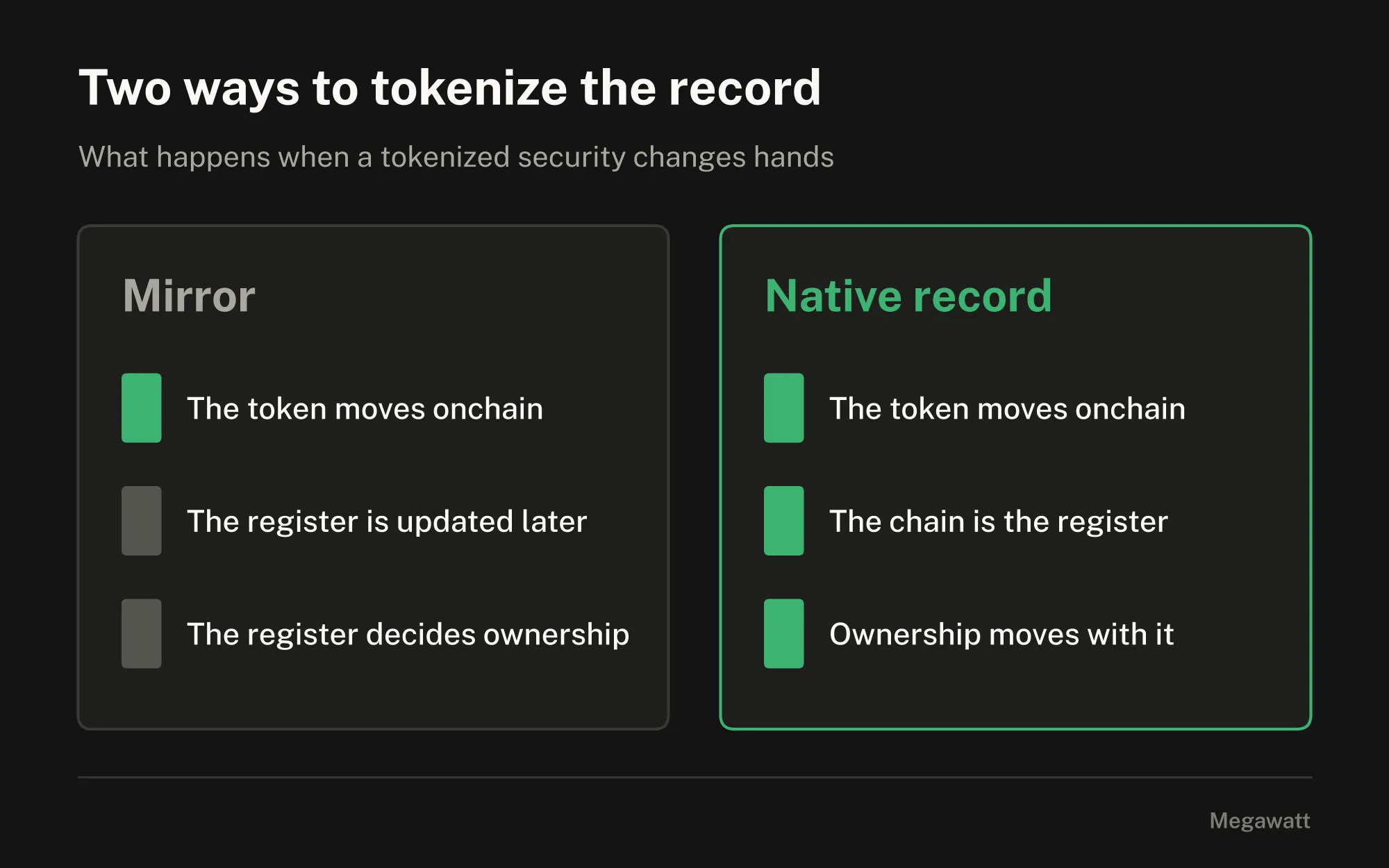
A mirror. The token moves onchain, and legal ownership moves only when the official register is updated. Two records exist, they can diverge, and the off-chain one decides.
A native record. The law, or the designated record-keeper, recognises the chain itself as the record of ownership. Transferring the token transfers the security.
What makes a record authoritative is statute, the licensing of whoever keeps it, the issuer’s own documents and, in the end, recognition by courts. None of that is technical. A well-built chain with no legal standing is a database. A spreadsheet kept by a licensed agent under a recognised framework is a register.
2026 took both routes
In August, BlackRock launched tokenized share classes for six of its European money market funds, with tokens transferable around the clock between approved investor wallets. Each token represents a fund share, and the official shareholder register continues to be kept through the fund’s transfer agent infrastructure. That is the mirror model, applied to one of the largest money market fund ranges in Europe.
In July, BNY announced a blockchain-based version of its transfer agency business, and Baillie Gifford said it planned to use it for what it called the first fully native UK-regulated tokenized fund. Its head of digital assets described the chain as a shared source of record-keeping that the participants agree is the source of truth.
Each model has a reason to exist. A mirror lets an existing fund add an onchain share class without changing its legal plumbing, and it keeps the fund’s existing investors and service providers. A native record closes the gap between the two records, and it needs a legal framework and an institution willing to stand behind the chain as the record.
The gap
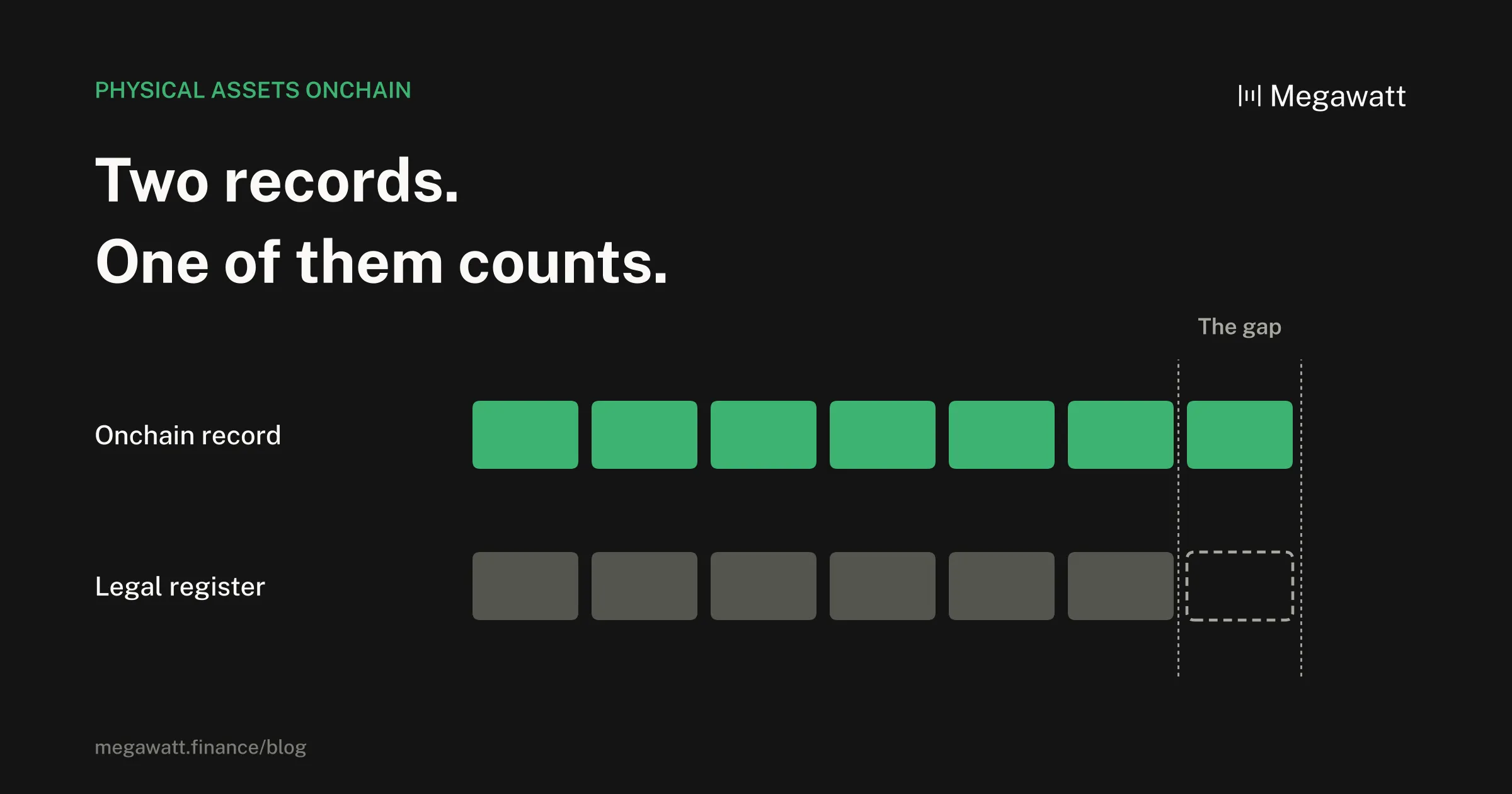
In the mirror model there is a period, however short, in which the chain and the register disagree. A token has moved and the register has not yet recorded it. Anything that happens in that window, a record date for a payment, a corporate action, a disputed transfer, an insolvency, is settled by the register.
That matters most for what gets built on top. A lending market that accepts a tokenized fund share as collateral, a vault that holds it, or a protocol that pays out against it, all rely on the token balance. If the register says something different, the register prevails. Offering documents can decline responsibility for issues that arise in that timing gap, and anyone building on a mirrored token should read for it, because that risk then sits with whoever relied on the token.
Where the law stands
A growing number of jurisdictions give legal effect to blockchain records. Switzerland’s DLT Act created ledger-based securities, rights that exist and transfer on a distributed ledger. The EU’s DLT Pilot Regime lets market infrastructures trade and settle securities on distributed ledgers under supervision. In the United States, some SEC-registered transfer agents now keep the official record onchain.
One piece is still being built. Settlement finality, the legal protection that stops a completed transfer being unwound when a participant fails, is granted to designated systems, and Europe’s framework for it was written long before blockchains. A chain can be fast and unalterable and still sit outside that protection. That argument is set out in Everything That Scaled Was Already Liquid.
Why it matters more for physical assets
For a money market fund, the register question is about who owns a share of a pool of short-dated government bills. For a solar farm or a battery, the token sits at the top of a longer chain: the token, the legal claim it represents, the entity that owes that claim, and the physical asset that entity owns, often in another country.
Each link has its own record. The share register of the company that owns the asset, the land registry, the grid connection agreement, the security over the equipment. A token can be technically perfect and still point at a claim that is weak further down. So the questions for a tokenized physical asset start below the chain: what the token gives the holder in law, against which entity, and which record proves it.
What to ask for
Anyone holding or building on a tokenized asset can ask:
- Is the token the legal record of ownership, or a mirror of a register kept elsewhere?
- If it is a mirror, who keeps the register, how often is it updated, and who is responsible for errors in the gap?
- What does the token give the holder in law: a share, a claim on the issuer, or a contractual right to a payment, and against which entity?
- If keys are lost or a contract fails, which record is used to restore holdings?
- Does the holder appear on the register directly, or only through an intermediary?
Where this is heading
Institutions that already keep registers are moving them onchain, and the law is catching up one jurisdiction at a time. The gap between the two records will narrow, and in some products it has already closed. What makes a record count is the institution and the law standing behind it, and those change more slowly than technology. Until they do, the clearest answer to “what do I own?” starts with knowing which record counts.
Key questions
What is a securities register? The legal record of who owns a security. Courts rely on it to decide who was entitled to payments, votes or assets in an insolvency.
Is a token the legal record of ownership? It depends on the structure. In a mirror model the token tracks a register kept elsewhere, and that register decides ownership. In a native model the law or the record-keeper recognises the chain itself as the record.
What is the gap between a token and a register? The time in which a token has moved onchain but the official register has not yet been updated. In a mirror model, the register decides anything that happens in that window.
What does a transfer agent do? It keeps the register for the issuer, records transfers, works out who is owed each payment, and handles investor communications and tax reporting.
What should investors ask about a tokenized asset’s ownership record? Whether the token is the legal record or a mirror, who keeps the register and how often it updates, what the token gives the holder in law, and against which entity.
Sources: The Block (BlackRock tokenized money market fund share classes, 4 August 2026); Cointelegraph, citing the Financial Times (BNY Digital Transfer Agency and Baillie Gifford, 29 July 2026).