Who Stands Behind the Warranty
A battery warranty is a long-dated promise from a company. What 2026 showed about that promise, and how investors can check it
Jacopo Buriollo, founder and CEO, Megawatt
In brief
A battery storage project usually comes with long warranties: capacity, availability and performance guaranteed for ten to fifteen years. Investors read those guarantees as protection, and they are, for as long as three conditions hold. The company that gave the warranty has to still be there. The owner has to hold the data that proves a shortfall. And the terms have to fit the way the battery is actually run. In 2026, three German battery storage businesses entered insolvency proceedings within three months. All three sold mainly home and commercial systems, and the lesson travels: a warranty is a counterparty exposure, and it deserves the same scrutiny as any other.
What a battery warranty promises
A utility-scale battery is typically covered by several promises, split between the supply contract and a long-term service agreement:
- Capacity. How much energy the battery will still hold as it ages, usually as a curve that steps down over the years.
- Availability. The share of time the system is ready to deliver what it is contracted to deliver, often promised in the high nineties, with compensation owed below that level.
- Performance. Round-trip efficiency, the energy lost between charging and discharging, and how quickly the system responds.
- Defects. Repair or replacement of failed components within set periods.
Each promise comes with conditions: limits on cycling, temperature and state of charge, approved control software, and maintenance by approved parties. Break a condition and the promise can lapse.
Three insolvencies in three months
In late July, Varta filed for self-administered insolvency proceedings, with its storage business, which makes solar storage systems in Germany, among the units included. The company said production, service and customer support were expected to continue under the applicable insolvency rules.
In September, RCT Power, a maker of residential and commercial battery storage, entered provisional insolvency proceedings. Reports in the months before had described rising customer complaints and difficulty replacing or repairing equipment.
In October, sonnen, one of the best-known names in home storage, filed for insolvency two months after Shell sold it to a new owner. It said it intended to keep supporting its more than 150,000 existing customers, and how that support, software included, would work during the restructuring was left open.
These are home and commercial storage businesses, and utility-scale projects buy from different suppliers under different contracts. The pattern still applies. A battery is warranted for ten to fifteen years, longer than many companies in a fast-growing, low-margin industry stay in the same shape. Insolvency is one way a supplier changes. A sale, a restructuring, a merger or an exit from a product line are others, and each can change who honours a warranty and how willingly.
A warranty is a credit exposure
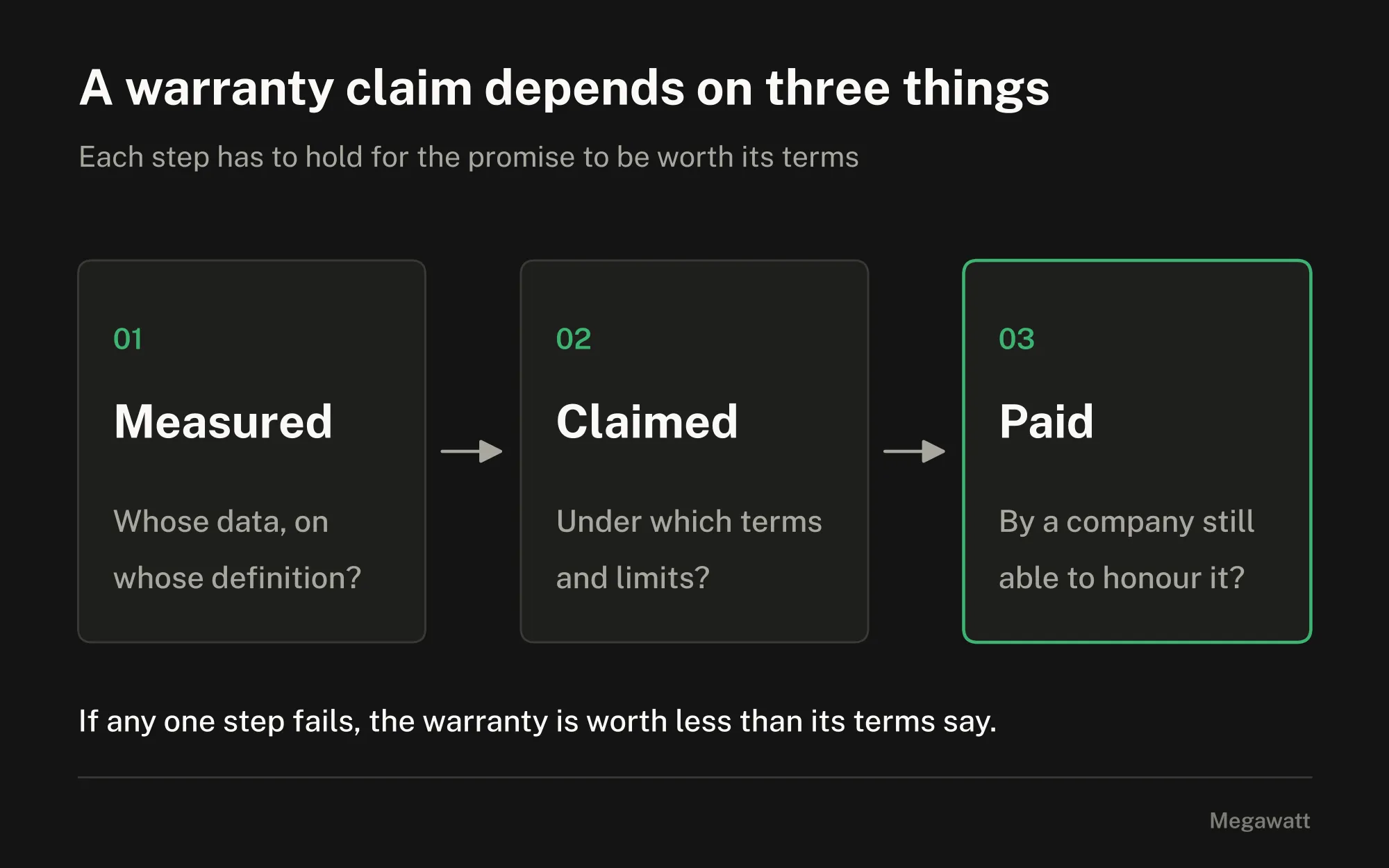
From an investor’s side, a warranty is a claim on a company’s future ability to repair, replace or pay. That makes it a credit exposure, and it raises the questions any credit exposure raises:
- Who is the obligor? The local subsidiary that signed the contract, the parent group, or an insurer standing behind both.
- What backs the promise? A parent company guarantee, a bank guarantee, an insurance policy, or nothing beyond the signing entity’s own balance sheet.
- Where is it enforced? Under which law, in which courts, and how long that takes when the obligor sits on another continent.
- What happens on a change of control? Whether the promise passes to a buyer of the business, and on what terms.
The country the equipment comes from matters less than these answers. What decides the value of the warranty is enforceability: against whom, in which court, ten years from now.
Some equipment makers now also invest in storage projects of their own. A supplier in that position sits on both sides of its warranties: it guarantees performance to project owners and, elsewhere, competes for the same projects and the same revenue. That can work well, and it makes independent measurement of availability and degradation more important.
The claim depends on the data
A warranty claim has to prove something: that capacity fell below the curve, that availability fell below the guaranteed level, that a failure falls within the defect terms. The proof comes from operating data, and in most projects that data is collected by the supplier’s own monitoring system and calculated on the supplier’s own formula. When the supplier’s figure says the guarantee was met, the owner needs data of its own to show otherwise.
The gap is measurable. An analysis of more than 50 operating storage projects by ACCURE Battery Intelligence, with support from U.S. Bank, found that three sites in four over-reported their own availability, mostly because of definitions: a unit counted as available once it was online, even if it did not respond. More than half of the downtime came from small, recurring outages, the kind that rarely triggers a claim on its own. The same theme runs through A Number You Can Check: a figure reported by the system being judged tends to drift in one direction.
Supplier failure adds a second data risk. Monitoring platforms and control software often run on the supplier’s own systems. If the supplier stops operating, the owner can lose the history needed to make a claim and the tools needed to run the asset, at the same moment.
The terms have to fit how the battery runs
Warranties limit how a battery can be used: cycles per day or per year, depth of discharge, temperature. Trading strategies change over a battery’s life, and the most valuable strategy in year six may cycle the battery harder than the warranty assumed in year one. Running harder than the terms allow can void the warranty. Running more gently than the market rewards leaves revenue unearned. That trade-off has to be decided with the warranty in hand, and revisited whenever the operating strategy changes. How a battery’s revenue streams compete for the same capacity is covered in Battery Storage Revenue Stacking.
What is changing
Buyers are pushing for common terms. This autumn a group of storage buyers, developers and an insurer among them, formed the Energy Storage Contract Alliance to draft an open model contract for utility-scale battery procurement, warranties included. Long-term performance insurance from large insurers also exists, and it moves part of the promise onto a balance sheet built to carry it. Both make warranties easier to compare. Neither removes the need to know who stands behind each one.
What to ask for
Anyone relying on a battery warranty can ask:
- Which entity gives each warranty, and what stands behind it: a parent guarantee, a bank guarantee or insurance?
- What happens to the warranty if the supplier is sold, restructured or insolvent?
- Who measures availability and capacity, on what definition, and can the owner see the raw data for the full term?
- Do the monitoring and control systems keep working if the supplier’s own systems go offline, and does the owner keep the history?
- Do the cycling and operating limits fit the trading strategy, today and as it changes?
- Where do spare parts and repair capacity come from, and how long do they take to arrive?
Where this is heading
Storage is becoming a large asset class with longer operating records, and warranty terms will converge as buyers compare notes. Supplier failures will keep happening in an industry growing this fast. The projects that come through them best will be those whose owners held their own data, knew who stood behind each promise, and checked the asset themselves.
Key questions
What does a battery storage warranty usually cover? Capacity retention over time, availability, round-trip efficiency and defects, usually for ten to fifteen years, subject to conditions on cycling, temperature and maintenance.
What happens to a battery warranty if the manufacturer becomes insolvent? It depends on the proceedings, the contract and what stands behind the warranty. Without a parent guarantee, a bank guarantee or insurance, an unpaid warranty claim can end up as one claim among many against an insolvent company.
Why is a battery warranty a counterparty risk? Because it is a promise to repair, replace or pay years in the future, and its value depends on the company still being able and willing to honour it.
Who should measure battery availability? Someone independent of the party guaranteeing it, or at least the owner with full access to the raw data, since the supplier’s own figure decides whether its own guarantee was met.
What should investors check in a battery warranty? The obligor and what backs it, the change-of-control and insolvency terms, how performance is measured and who holds the data, whether software keeps working without the supplier, and whether the operating limits fit the trading strategy.
Sources: ESS News (Varta, 27 July 2026; RCT Power, 17 September 2026); Electrek and pv magazine, citing Handelsblatt (sonnen, 22 October 2026); ACCURE Battery Intelligence with support from U.S. Bank, "Banking BESS" (2026); Energy-Storage.news (Energy Storage Contract Alliance, 2026).